
Top Types of Metal Mesh for Global Buyers
Global buyers rarely need “the strongest” metal mesh. They need the right balance of opening size, wire diameter, alloy, finish, and operating cost.
Market reports show steady expansion. Grand View Research identifies construction, filtration, automotive, and industrial applications as major demand areas. MarketsandMarkets also forecasts continued growth in wire mesh, driven by infrastructure investment, safety systems, and process filtration. Meanwhile, the World Steel Association reported global crude steel production above 1.8 billion tonnes in 2023. That scale supports broad material availability, but it does not guarantee consistent mesh quality.
“Structure determines properties,” says Dr. Lorna J. Gibson, a leading materials scientist whose work explains how geometry affects material performance. Her principle applies directly to metal mesh. A fine stainless steel screen may capture particles efficiently, yet clog quickly under heavy loading. A welded panel may provide rigid protection, but its joints can become stress points. Expanded metal offers strong, lightweight coverage, although its open pattern can complicate precise filtration.
This guide examines the top types of metal mesh for global buyers, including woven wire mesh, welded wire mesh, expanded metal, perforated sheet, and crimped mesh. Each type behaves differently under heat, pressure, vibration, corrosion, and repeated cleaning. ISO and ASTM specifications can improve comparison, but paperwork alone is not enough. A supplier’s sample, mill certificate, aperture inspection, and coating records matter.
Small details decide outcomes.
Buyers should question assumptions. A cheaper mesh may create higher replacement costs. A familiar alloy may still fail in chloride-rich air. This overview provides a practical framework for comparing options, suppliers, and performance requirements across international projects.
Metal Mesh Basics: Structure, Materials, and Key Classifications
Top Types of Metal Mesh for Global Buyers
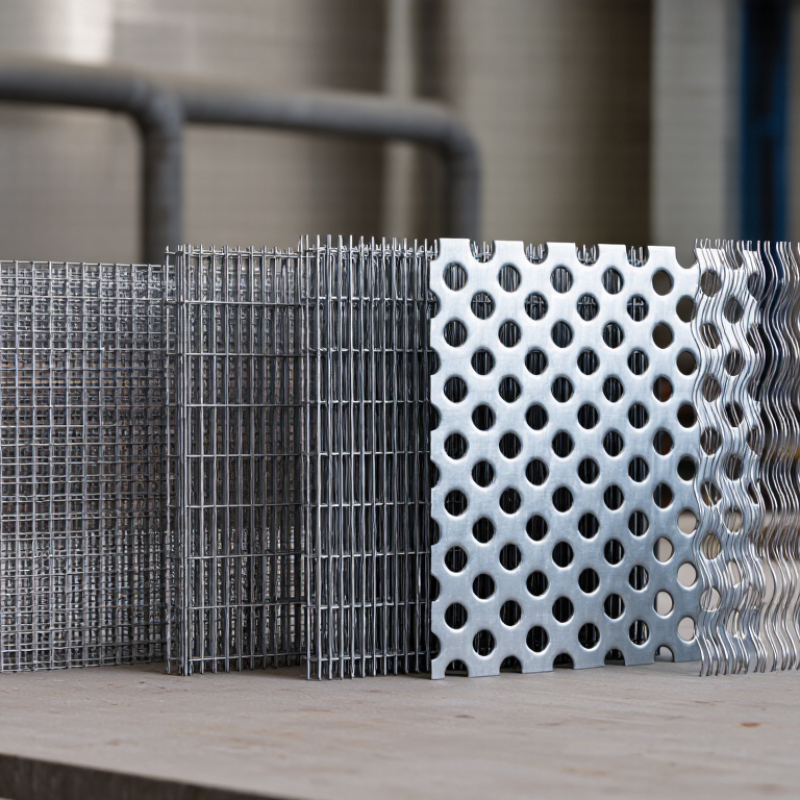
Metal mesh is defined by structure, opening pattern, wire size, and production method. Woven wire mesh uses interlaced wires, creating square or rectangular openings. Welded mesh joins crossing wires at fixed points, giving it stable dimensions and strong load support. Expanded metal is cut and stretched from one sheet, leaving diamond-shaped openings without loose joints. Perforated metal uses punched holes, often round, slotted, or square. Each type behaves differently under pressure, airflow, filtration, and repeated handling.
Material selection matters just as much. Stainless steel resists corrosion in humid or demanding environments. Carbon steel offers strength and cost efficiency, but it usually needs protective treatment. Aluminum is lightweight and easier to handle, although it may deform under higher loads. Plastic-coated or galvanized surfaces can improve service life, yet coating thickness must be checked. A visual inspection helps, but it is not enough.
Tips: Match the mesh to its actual working conditions. Check aperture size, wire diameter, panel tolerance, tensile strength, and surface finish. Request material certificates and inspection records when performance is critical. Confirm whether measurements use nominal or actual openings. Small differences can affect filtration and assembly. I have found that buyers often focus on price first, then discover that transport, cutting, or edge treatment changes the real cost. Check the drawing. Ask for samples when the application is uncertain.
Top Types of Metal Mesh for Global Buyers - Metal Mesh Basics: Structure, Materials, and Key Classifications
| Mesh Type | Basic Structure | Common Materials | Typical Opening or Pattern | Key Performance Features | Typical Applications | Main Selection Considerations |
|---|---|---|---|---|---|---|
| Woven Wire Mesh | Metal wires are interlaced in plain, twill, Dutch, or other weave patterns. | Stainless steel, carbon steel, galvanized steel, aluminum, copper, brass, and nickel alloys. | Square, rectangular, or highly controlled openings; commonly specified by mesh count and wire diameter. | Good particle separation, uniform openings, flexible configuration, and accurate filtration performance. | Screening, filtration, ventilation, chemical processing, food processing, and laboratory equipment. | Choose mesh count, wire diameter, material grade, weave type, temperature, and corrosion exposure. |
| Welded Wire Mesh | Longitudinal and transverse wires are joined at intersections by resistance welding. | Low-carbon steel, galvanized steel, stainless steel, and PVC-coated steel. | Usually square or rectangular openings, often supplied in panels or rolls. | Rigid construction, consistent spacing, fast installation, and good load distribution. | Fencing, animal enclosures, reinforcement, storage cages, partitions, and construction projects. | Check wire diameter, panel size, opening size, weld strength, surface coating, and environmental exposure. |
| Expanded Metal Mesh | A solid metal sheet is simultaneously slit and stretched to form interconnected openings. | Carbon steel, galvanized steel, stainless steel, aluminum, and copper. | Diamond, hexagonal, or decorative patterns; specified by SWD, LWD, strand width, and thickness. | High strength-to-weight ratio, no loose wires, slip resistance, and good airflow. | Walkways, platforms, machine guards, facades, ceilings, filters, and security barriers. | Select based on sheet thickness, opening dimensions, load requirements, free area, and orientation. |
| Perforated Metal | A metal sheet is punched, drilled, or laser-cut to create controlled holes. | Stainless steel, mild steel, galvanized steel, aluminum, and copper. | Round, square, slotted, rectangular, or custom holes in straight or staggered layouts. | Predictable open area, acoustic control, screening, ventilation, and decorative flexibility. | Air grilles, acoustic panels, equipment covers, architectural screens, guards, and filtration. | Specify hole shape, hole diameter or slot size, pitch, open-area percentage, sheet thickness, and finish. |
| Chain Link Mesh | A continuous wire is formed into interlocking diamond-shaped loops. | Galvanized steel, aluminum, stainless steel, and polymer-coated steel. | Diamond openings commonly selected by mesh size and wire gauge. | Flexible, economical, easy to install, transparent, and suitable for large-area fencing. | Property boundaries, sports facilities, security fencing, agricultural areas, and temporary barriers. | Consider mesh opening, wire diameter, fence height, edge treatment, coating, posts, and local regulations. |
| Knitted Wire Mesh | One or more wires are knitted into a continuous looped structure, often supplied as pads or rolls. | Stainless steel, copper, aluminum, nickel alloys, and galvanized steel. | Looped, crocheted, or compressed mesh; may be formed into round, rectangular, or demister pads. | Flexible, resilient, vibration-damping, and effective for mist and droplet separation. | Demister pads, gas-liquid separation, exhaust systems, vibration isolation, and sealing components. | Evaluate wire diameter, knit density, pad thickness, compression, operating temperature, and chemical compatibility. |
| Sintered Wire Mesh | Multiple layers of woven wire mesh are bonded through pressure and controlled heat treatment. | Stainless steel and specialized nickel-based alloys. | Multi-layer, three-dimensional pore structure with defined filtration ratings. | High mechanical strength, stable porosity, cleanability, and resistance to high pressure and temperature. | Hydraulic filtration, polymer processing, pharmaceutical equipment, gas filtration, and process plants. | Specify filtration rating, layer configuration, permeability, pressure drop, temperature, and cleaning method. |
| Square Wire Mesh | A woven wire mesh classification in which the warp and weft wires create substantially square openings. | Stainless steel, galvanized steel, low-carbon steel, aluminum, brass, and copper. | Square openings; commonly identified by mesh count, aperture, and wire diameter. | Balanced structure, reliable screening, and broad availability in industrial and general-purpose grades. | Sieving, guards, window screens, drying racks, ventilation, and general fabrication. | Match the clear aperture and wire diameter to the required screening accuracy, strength, and flow rate. |
| Hexagonal Wire Mesh | Wires are woven or twisted to form a repeating hexagonal opening pattern. | Galvanized steel, PVC-coated steel, stainless steel, and aluminum. | Hexagonal openings in light, medium, or heavy wire constructions. | Flexible, lightweight, conformable, and effective for containment and surface protection. | Gabions, erosion control, poultry housing, landscaping, plaster reinforcement, and protective cages. | Consider coating life, wire diameter, mesh opening, twisting method, environmental conditions, and required flexibility. |
Related Posts
-
What is Metal Mesh and How is it Used in Industry?
-
How to Choose the Right Steel Wire Mesh for Your Project?
-
2025 How to Choose the Best Stainless Steel Mesh Screen for Your Needs
-

10 Best Stainless Steel Mesh Options for Versatile Applications
-
Essential Tips for Choosing the Right Stainless Steel Mesh for Your Project
-

What is Stainless Steel Mesh and Its Applications?