How to Choose the Best Stainless Steel Mesh for Your Needs?
Choosing the right stainless steel mesh can significantly impact your project’s success. According to a recent report by the Metal Mesh Association, the global market for stainless steel mesh is projected to grow by 6.5% annually. This growth reflects the increasing demand across multiple industries, including construction and filtration.
Expert Anna Reynolds, a leading figure in the stainless steel mesh industry, states, "Selecting the correct mesh type can enhance performance and longevity." However, many users struggle to navigate the wide variety of options available. Different applications require specific mesh grades and sizes, which can be overwhelming.
Purchasing stainless steel mesh without thorough research can lead to mismatches in quality and performance. It's important to ask the right questions. Consider the application, environment, and required durability. Balancing cost and quality also poses a challenge. Understanding these factors will help in making an informed decision that ensures optimal usage.

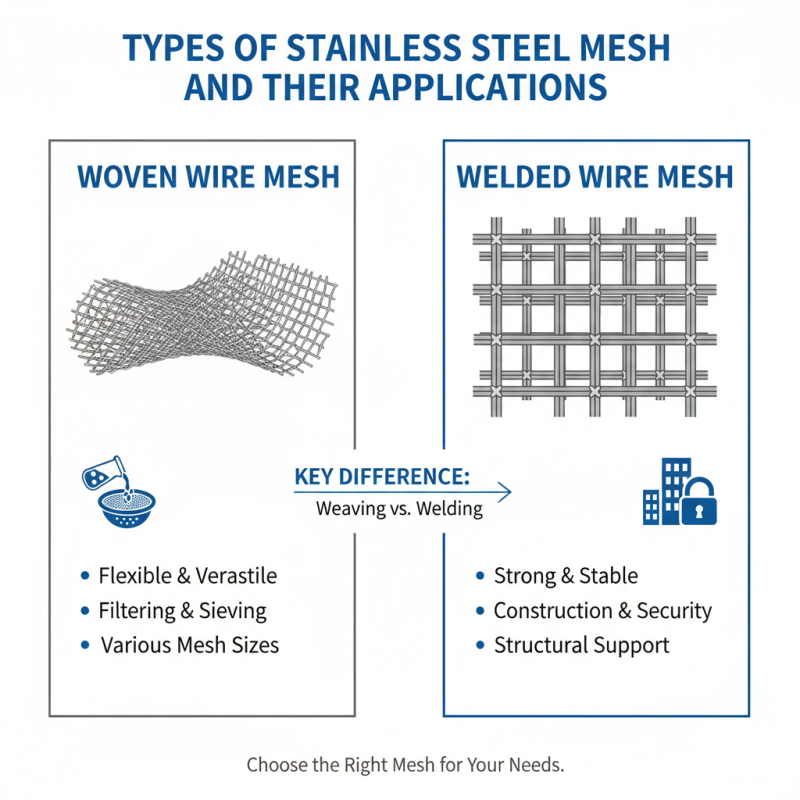
Types of Stainless Steel Mesh and Their Applications
When selecting stainless steel mesh, it's crucial to understand the various types available. Each type has unique characteristics that fit specific needs. Woven wire mesh is widely used for filtering and sieving. It's available in different mesh sizes, allowing for versatility in applications. On the other hand, welded wire mesh offers greater strength and stability, making it suitable for construction and security purposes.
Another type is perforated sheet mesh, which features holes punched into flat sheets. This design is excellent for ventilation or drainage applications. Expanded metal mesh is also noteworthy, as it provides a lightweight option while maintaining structural integrity. Each type has its own advantages and potential drawbacks. You may find that some options are less durable or more challenging to work with. Evaluating your specific requirements will help guide your choice. Every project has its complexities, and understanding the mesh types leads to better-informed decisions.
Key Factors to Consider When Choosing Stainless Steel Mesh
When selecting the right stainless steel mesh, consider key factors to ensure optimal performance. The mesh size is crucial. Different applications require varied openings. A finer mesh traps smaller particles, while a coarser mesh allows for better airflow. Industry reports indicate that mesh sizes range from 20 to 400 microns. Understanding your needs will guide the selection process.
Another important factor is the wire diameter. Thicker wires yield stronger mesh structures. However, they may weigh more and limit flexibility. Balancing strength and weight is essential. A report from the Stainless Steel Manufacturers Association (SSMA) highlights that choosing the wrong wire gauge can lead to premature failure. Test the mesh under expected conditions for reliability.
Tips: Assess the environment where the mesh will be used. If exposed to corrosive elements, choose higher-grade stainless steel like 316. This grade offers better resistance compared to 304. Always consult technical data sheets for specifications. Evaluate suppliers' certifications for quality assurance. These steps can help secure a dependable choice, avoiding issues down the line.
How to Choose the Best Stainless Steel Mesh for Your Needs? - Key Factors to Consider When Choosing Stainless Steel Mesh
| Aspect |
Details |
| Mesh Size |
Consider the aperture size for your application, ranging from coarse to fine mesh. |
| Wire Diameter |
Thicker wires provide increased durability, whereas thinner wires allow for finer filtration. |
| Grade of Stainless Steel |
Common grades are 304 and 316; 316 is more corrosion resistant, suitable for marine environments. |
| Welded or Woven |
Welded mesh is typically stronger, while woven mesh is generally more flexible. |
| Application Type |
Define the intended use such as filtration, safety barriers, or decorative purposes. |
| Corrosion Resistance |
Assess if the mesh will be exposed to harsh conditions requiring higher resistance levels. |
| Load Bearing Capacity |
Determine how much weight the mesh needs to support in your specific application. |
Understanding Stainless Steel Grades for Mesh Selection
When selecting stainless steel mesh, understanding the different grades is crucial for optimum performance. Stainless steel is categorized by its composition, which typically includes iron, chromium, and nickel. Common grades include 304, 316, and 430, each offering distinct properties suited for various applications. According to industry reports, grade 304 is popular due to its excellent corrosion resistance and weldability, making it suitable for general applications. In contrast, grade 316 contains molybdenum, enhancing its ability to resist chlorides, making it ideal for marine and chemical environments.
Tips for selection: Always consider the environment. If exposure to saltwater is possible, grade 316 is preferable. For food and beverage applications, grade 304 is often sufficient. Understand the specific demands of your project and the mesh's intended use. Data shows that a poorly chosen mesh can result in premature failure. Therefore, thorough compatibility assessment is essential.
Another critical aspect is the mesh's aperture size. A finer mesh allows liquid and air flow while filtering out larger particles. Insightful reports indicate that selecting the right aperture size can significantly affect performance and longevity. Be cautious, as an overly fine mesh may lead to clogging, while a larger size may not provide the desired filtration. Exploring these factors will help make informed decisions, ensuring optimal performance of the stainless steel mesh.
Mesh Size and Open Area: What You Need to Know
When selecting stainless steel mesh, understanding mesh size and open area is crucial. Mesh size is typically defined by the number of openings per linear inch. For instance, a mesh size of 100 indicates 100 openings per inch. This metric directly influences both filtration efficiency and strength. A finer mesh, like 200, provides better filtration but may lack strength when dealing with heavy loads.
Open area, on the other hand, refers to the percentage of the mesh that is unblocked. A higher open area allows for better airflow and liquid passage. According to industry data, a mesh with 60% open area is often optimal for applications that require both strength and filtration. Conversely, a mesh with only 30% open area might be suited for more aggressive filtering tasks. However, finding the right balance is key. Too high an open area may compromise structural integrity.
Deciding between different mesh sizes and open areas often involves trade-offs. For example, certain applications may demand a finer mesh but could lead to clogging issues. This complexity highlights the importance of thoroughly assessing your specific needs. Pay attention to usage conditions and potential challenges. A mismatch might not only impact performance but could also lead to increased costs down the line.
Tips for Maintaining and Cleaning Stainless Steel Mesh
Maintaining stainless steel mesh is crucial for durability and functionality. Regular cleaning helps prevent corrosion and buildup of debris. A simple rinse with water often suffices for light dirt. More stubborn grime may require a mild detergent. Make sure to use soft cloths or brushes to avoid scratching the surface.
When cleaning, pay attention to the type of stainless steel used. For example, 304 stainless steel is resistant to corrosion but not immune. A survey by the Corrosion Engineering Society found that improper cleaning can reduce the lifespan of stainless steel components by up to 50%. Thus, using the right method can extend its service life significantly.
Store stainless steel mesh in a dry place. Avoid exposure to harsh chemicals, as they can weaken the material. For maintenance, regularly inspect your mesh for signs of wear or damage. Addressing small issues early can prevent larger problems later. Keep in mind, even stainless steel requires care to maintain its luster and effectiveness.