
A Heat Gun may look simple, but its performance depends on precise temperature control, stable airflow, safe insulation, and durable components. For global buyers, the supplier matters as much as the tool. A crowded workshop quickly reveals weak switches, inconsistent heat, or poor after-sales support.
Market data offers useful context, though it requires careful interpretation. Grand View Research’s Power Tools Market Size, Share & Trends Analysis Report estimated the global power tools market at about US$36.4 billion in 2023. It projected continued growth through 2030. This broad category includes many products, not just heat guns. It signals demand for powered equipment, but it cannot prove that any individual manufacturer is reliable.
That distinction matters. This guide to China’s top 10 heat gun manufacturers for global buyers focuses on practical checks: product range, temperature and airflow specifications, quality-control procedures, customization options, and export experience. Buyers should also examine test records, warranty terms, spare-part availability, and communication responsiveness. Ask how a model performs after repeated heating cycles, not only during a showroom demonstration. Details count.
A polished catalogue is not evidence enough. Supplier claims still need verification through samples, factory documentation, and clear commercial terms. No ranking can replace that work. Some comparisons may remain imperfect, especially when factories disclose different levels of technical information. The goal is not to promise a flawless purchase. It is to help buyers ask sharper questions and shortlist manufacturers with evidence behind their claims.
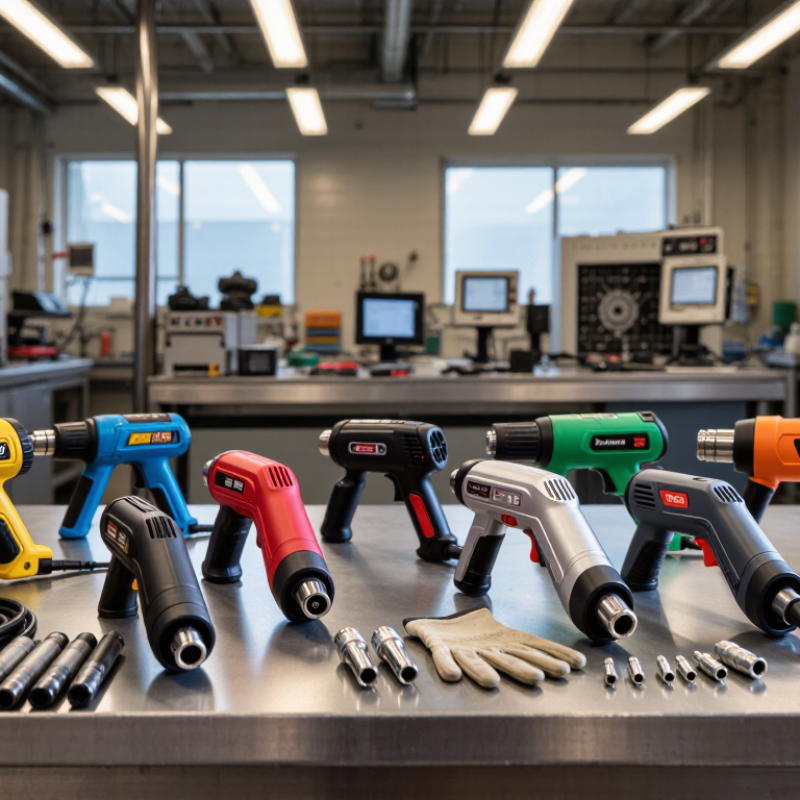
China’s heat gun manufacturing industry benefits from a broad base of metalworking, plastics, electronics, and tool-component suppliers. MIIT reported that China’s manufacturing value added reached RMB 33.6 trillion in 2023, representing 26.2% of GDP. This figure describes the wider industrial ecosystem, not heat gun output alone. Public statistics do not consistently separate heat guns into a standalone product category.
For buyers, manufacturing depth can mean more options in heating elements, housings, airflow design, and temperature controls. But production scale is not a quality guarantee. Small details matter. Check temperature stability, airflow consistency, cable construction, and test records on sample units.
Ask how the supplier controls heater assembly and verifies performance across batches. I would not judge a factory by its catalog alone; a neat specification sheet can hide uneven workmanship. Better evidence comes from repeatable test results and clear quality procedures.
That takes time. Compare samples under the same operating conditions before placing a large order.
When evaluating Chinese heat gun manufacturers, inspect more than product photos and price sheets. Ask how the factory controls heating elements, temperature sensors, and airflow during production. Request test records for sample units, then compare the stated temperature range with readings from a calibrated thermometer. Small gaps matter. A gun that overheats near its nozzle may damage nearby surfaces, even when its display looks accurate.
Check whether the manufacturer can explain its quality process in plain terms. Ask how workers detect loose power cords, uneven casing seams, or unstable temperature settings. Review the instruction manual and packaging for clear operating guidance. Request samples from more than one production run if possible; one polished sample does not prove consistent output. Ask about spare-part availability and typical response times, too. Vague answers are a warning, though not always proof of poor production.
Factory visits or live video inspections can reveal useful details: workstations, testing equipment, and how finished units are stored. Verify certificates against the exact model, rather than assuming one document covers every product. No checklist catches everything. Buyers may still overlook a weak point, especially when time is short. Leave room for a small pilot order and document any defects before scaling up.
These ten profiles compare Chinese heat-gun manufacturers by practical strengths, not catalog size alone. They examine production focus, temperature control, airflow stability, safety features, and export support. Some factories emphasize compact units for repair benches; others build heavier tools for continuous workshop use. The profiles also consider heating-element design, handle balance, cord quality, and access to replacement parts. Small details matter. A stable display means little if the tool’s measured output fluctuates under load.
Grand View Research valued the global power-tools market at US$36.2 billion in 2023 and projected 3.9% annual growth from 2024 to 2030. This report covers power tools broadly, not heat guns alone, so it offers market context rather than a heat-gun forecast. Buyers should request comparable test data, including warm-up time, outlet temperature, airflow settings, and duty-cycle limits. Factory specifications are useful, but independent verification is better. Some claims still need closer checking.
Tips: Ask for sample units and test them at the same distance and setting. Check airflow with a meter, not by feel. Review warranty terms, spare-part access, and inspection records before placing a large order. A polished brochure is not proof.
Heat guns are commonly grouped by temperature control, airflow, and intended workload. Basic models use fixed or stepped settings for paint removal, shrink tubing, and drying. Digital models offer finer temperature adjustment, while industrial units may provide stronger airflow and continuous-duty components. Compact designs suit repair benches; larger housings can handle extended workshop use. Different jobs need different heat.
Manufacturing capability involves more than final assembly. A capable producer should control heating-element winding, handle insulation, nozzle fit, and temperature-sensor placement. These details affect warm-up time and how steadily heat reaches a workpiece. Production checks may include temperature readings, airflow tests, electrical safety checks, and repeated operating cycles. Buyers can ask how samples are tested and whether test records match the delivered model. Specifications can look better than reality. I would verify them with a sample, especially when a project needs consistent output across many units.
For global buyers, a heat gun’s export file should match the exact model, voltage, plug, and destination market. IEC 60335-1 and IEC 60335-2-45 provide relevant safety requirements for household appliances and portable heating tools. Ask for test reports that identify the same model number printed on the product label. A similar-looking report is not enough. Check temperature control, cord condition, insulation, and overheat protection; these details matter when a tool runs continuously on a workbench.
Destination checks go beyond electrical safety. Buyers may need evidence for applicable EMC, chemical-substance, labeling, and import requirements, depending on the market. Confirm whether documents come from a qualified testing laboratory, and verify language, validity, and model coverage before shipment. The World Bank’s 2023 Logistics Performance Index assessed 139 economies across six dimensions, including customs and shipment timeliness. That data is a useful reminder: a compliant product can still face delays if its paperwork or shipping plan is weak.
Trade conditions also shift. The WTO’s April 2024 Global Trade Outlook reported that merchandise trade volume fell 1.2% in 2023 and projected 2.6% growth for 2024. Treat that projection as a dated forecast, not a guarantee. Request a pre-shipment sample and inspect its label against the test file. Paperwork is not everything. Buyers can still overlook small inconsistencies, especially when several versions share one carton design.
Anonymized supplier capability comparison and export-readiness checklist
Important: The ten entries below are product and capability profiles for buyer evaluation, not named companies, verified suppliers, or a ranked list. Technical figures are indicative market ranges; confirm the exact model specifications and test evidence with each supplier.
| Profile | Typical product category | Indicative power and temperature range | Features to verify | Export compliance to confirm | Key buyer checks |
|---|---|---|---|---|---|
| 01 | Entry-level corded heat gun | Typically 1,500–2,000 W; commonly two or more fixed heat settings, often around 300°C and 500°C. | Over-temperature protection, stable stand, insulated handle, and included nozzle types. | For EU sales, check applicable CE requirements, including electrical safety, EMC, and RoHS obligations. Request the supporting technical documentation. | Confirm rated voltage and frequency, plug type, cord length, carton contents, and whether temperature figures are measured at the outlet. |
| 02 | Variable-temperature DIY model | Typically 1,600–2,000 W; adjustable settings commonly cover approximately 50–600°C. | Temperature adjustment method, airflow settings, cooldown procedure, and protection against overheating. | Check the regulations and conformity-assessment route for the destination market; do not treat a supplier’s CE mark alone as proof of compliance. | Request temperature-control accuracy, airflow data, and test results at the intended voltage and frequency. |
| 03 | Digital-display heat gun | Typically 1,800–2,000 W; many models offer setpoints within an approximate 50–650°C range. | Display readability, temperature adjustment steps, memory function, and sensor response. | For Great Britain, confirm the marking and documentation accepted for the product and applicable rules at the time of shipment. | Ask whether displayed temperature is a setpoint or a measured outlet temperature, and request accuracy and repeatability data. |
| 04 | Compact or lightweight corded model | Often around 1,000–1,500 W; temperature ranges vary by design and may be more limited than full-size models. | Weight, grip comfort, cooling time, stability when placed down, and thermal protection. | Confirm electrical safety and EMC requirements for the destination; verify that documentation covers the exact model and configuration. | Check continuous operating-time limits, duty-cycle guidance, and whether the smaller housing affects cooling or accessory compatibility. |
| 05 | Professional variable-control model | Commonly about 1,800–2,200 W; some models provide a broad adjustment range extending to approximately 650°C. | Independent temperature and airflow control, durable switch, stable stand, and replaceable accessories where applicable. | For US or Canadian markets, confirm the required electrical safety certification or listing for the intended use and buyer requirements. | Request endurance-test information, production inspection criteria, spare-parts availability, and warranty terms. |
| 06 | Dual-setting general-purpose model | Typically 1,500–2,000 W; two airflow and heat combinations are common, with exact temperatures depending on the model. | Clearly identified settings, nozzle retention, cord strain relief, and a stable cool-down position. | For Australia and New Zealand, check applicable electrical-safety requirements and the relevant RCM obligations for the product and supply arrangement. | Verify the correct plug and voltage, labeling, user manual language, and packaging requirements for each destination. |
| 07 | Model with memory or preset functions | Usually within the 1,800–2,000 W corded class; operating temperatures are model-specific and often adjustable across a broad range. | Preset behavior, restart settings, display units, and safe shutdown or cooling functions. | Where electronic controls are fitted, confirm applicable EMC requirements and any market-specific documentation obligations. | Test saved settings after power interruption and confirm that firmware or control-board changes are covered by compliance documents. |
| 08 | Heat gun supplied with accessory kit | Often around 1,500–2,000 W; temperature and airflow depend on the included tool model. | Accessory material, fit, heat resistance, and compatibility with the supplied outlet diameter. | Confirm that accessories included in the retail package are covered by applicable safety, labeling, and chemical-substance requirements. | Obtain a precise packing list and confirm that manuals explain safe nozzle changes and handling of hot accessories. |
| 09 | Battery-powered cordless model | Commonly based on an 18–20 V battery platform; output, runtime, and temperature capability vary substantially by battery and design. | Battery compatibility, runtime under load, thermal protection, charger requirements, and battery-removal procedure. | Check separate requirements for the tool, battery, and charger. For lithium batteries shipped internationally, request applicable UN 38.3 test-summary information and confirm transport rules. | Compare runtime using a stated battery capacity and operating setting; verify whether batteries and chargers are included in the shipment. |
| 10 | Heavy-duty or higher-output corded model | Some models are rated above 2,000 W; temperature capability and current draw must be checked against the destination voltage. | Thermal cut-out, airflow performance, power-cord rating, stable support, and continuous-use limitations. | Confirm the product’s rated voltage, plug, electrical safety evidence, and destination-market requirements; check that the installation or workplace conditions are suitable. | Calculate current from the nameplate rating and supply voltage, and confirm that the intended outlet and circuit can support the load. |
Standards and sourcing note: IEC 60335-1 and IEC 60335-2-45 may be relevant references for applicable portable heating tools, but the correct standard and conformity route depend on product design and destination market. Request model-specific test reports, a declaration of conformity where applicable, nameplate artwork, user instructions, and shipment-specific packaging details. Verify current legal requirements independently before placing an order.