
What Are the Best Petroleum Refining Catalysts from China?

Choosing the best Petroleum Refining Catalysts from China requires more than comparing price or advertised activity. Refinery performance depends on crude composition, unit design, operating temperature, and product specifications. A catalyst that performs well in a coastal refinery may disappoint in a high-sulfur inland plant.

Nobel Prize-winning chemist Paul Sabatier defined catalysis as “the acceleration of a chemical reaction by a substance which itself undergoes no permanent chemical change.” This principle still guides modern refining decisions. Chinese manufacturers now supply FCC catalysts, hydroprocessing catalysts, reforming catalysts, and specialty adsorbents for diverse refinery conditions. Their strongest products often combine zeolite engineering, controlled pore distribution, and stable metal dispersion.

Real evaluation needs evidence. Ask for fresh and equilibrium catalyst data, pilot-test results, regeneration behavior, and batch-to-batch consistency. Examine conversion, selectivity, hydrogen consumption, pressure drop, and coke yield. Small details matter, such as catalyst particle strength after repeated regeneration. They can affect an entire unit.

Some suppliers offer impressive laboratory numbers. Field performance may differ. That is an uncomfortable but necessary warning. Independent testing and a controlled plant trial remain more reliable than brochures. This guide compares leading Chinese options through technical capability, manufacturing experience, quality control, technical service, and compliance documentation. It also considers lifecycle cost, not merely the initial purchase price. The best choice is rarely the cheapest one. It is the catalyst that delivers stable results, predictable operation, and measurable value under your refinery’s actual conditions.
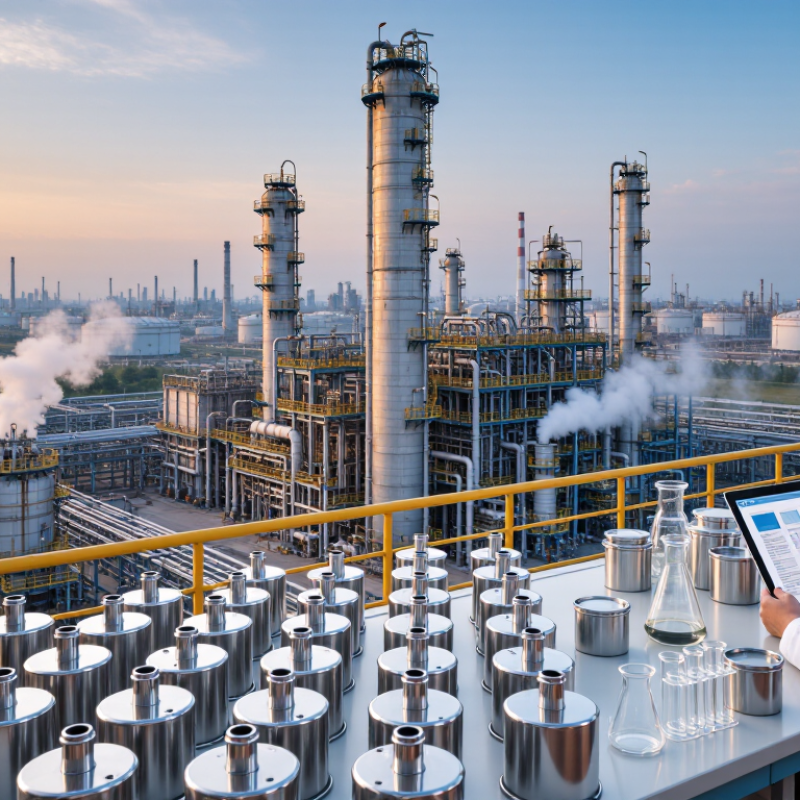
What Are the Best Petroleum Refining Catalysts from China?

How Petroleum Refining Catalysts Work

Petroleum refining catalysts work by speeding up chemical reactions without being consumed in the final reaction. Their surfaces provide active sites where large hydrocarbon molecules can break, rearrange, or remove unwanted elements. In fluid catalytic cracking, porous materials split heavy molecules into lighter fuels. In hydrotreating, metal-based sites help remove sulfur and nitrogen when hydrogen is present. Reforming catalysts rearrange molecules and can improve fuel quality.

Performance depends on more than the catalyst name. Temperature, pressure, feed composition, and hydrogen purity all matter. A catalyst with strong acidity may crack efficiently, but excessive acidity can increase coke formation. Metals can improve hydrogen-related reactions, yet they may lose activity after contamination. My practical view is cautious: laboratory results rarely predict every refinery condition. Pilot testing, batch consistency, pore structure, mechanical strength, and documented quality controls deserve equal attention. Independent analysis can reveal problems that a sales sheet misses.

Tips: Match the catalyst to the unit and feedstock. Request recent activity, stability, and regeneration data. Check particle size and crushing strength before loading. Monitor pressure drop, product quality, and coke trends during operation. Small changes can signal deactivation early. Do not judge performance from initial conversion alone; stable activity over time is often more valuable. A clear technical support process also matters, especially when operating conditions change unexpectedly.

Which Types of Refining Catalysts Are Made in China

China produces a broad range of petroleum refining catalysts, not one universal “best” option. The main categories include fluid catalytic cracking catalysts, hydroprocessing catalysts, catalytic reforming catalysts, isomerization catalysts, and sulfur-recovery catalysts. FCC units commonly use zeolite Y or ZSM-5 within alumina and clay matrices. These materials help convert heavy gas oils into gasoline-range products and light olefins.

Hydroprocessing catalysts usually combine nickel-molybdenum or cobalt-molybdenum with alumina supports. They remove sulfur and nitrogen from diesel, kerosene, and vacuum gas oil.

Platinum-based catalysts are also manufactured for reforming and isomerization services. Molecular-sieve catalysts support selective conversion under controlled temperature and hydrogen conditions.

According to China’s National Bureau of Statistics, domestic crude processing reached approximately 734.8 million tonnes in 2023. That large operating base supports continuous catalyst testing, regeneration, and process adjustment.

The International Energy Agency’s Oil 2024 report recorded roughly 1.6 million barrels per day of global refining-capacity growth in 2023, led largely by China and the Middle East. This expansion increases demand for FCC, hydrotreating, and residue-conversion catalysts.

Performance still depends on feedstock, reactor design, metals contamination, and operating severity. A catalogue is not a guarantee. Chinese suppliers may offer strong customization, shorter delivery routes, and competitive technical support, but independent pilot testing remains necessary.

One weakness is uneven public disclosure of long-cycle performance data. Refiners should compare activity, selectivity, attrition resistance, regeneration behavior, and catalyst life under their actual feed conditions.

How Chinese Catalysts Perform in Key Refining Processes

Chinese petroleum refining catalysts are gaining attention because they combine competitive pricing with improving process performance. Their value depends on the refinery, feedstock, and operating targets. A catalyst that performs well with light crude may struggle with heavier feeds.

In fluid catalytic cracking, Chinese catalysts can provide strong activity and useful gasoline yields. Operators often examine conversion, coke formation, and bottoms reduction during pilot testing. Practical trials matter. Laboratory data alone can miss pressure changes, feed impurities, and regeneration behavior. Some formulations also support better metal tolerance, which helps when processing high-contaminant feedstocks.

Hydrotreating catalysts from China commonly use nickel-molybdenum or cobalt-molybdenum systems. They can reduce sulfur and nitrogen under carefully controlled hydrogen pressure and temperature. In commercial units, stability matters as much as initial activity. A catalyst may start strongly but lose performance faster than expected. That risk deserves attention. Reforming catalysts can also support octane improvement and hydrogen production, although carbon deposition remains a concern. Refiners should compare cycle length, pressure drop, mechanical strength, and spent-catalyst handling through independent testing. Technical documents are useful, but they do not replace plant experience. Results can vary between batches, and quality control may not always be perfectly consistent. A careful procurement process should include sample analysis, reference data, and a monitored loading plan.

What Are the Best Petroleum Refining Catalysts from China? - How Chinese Catalysts Perform in Key Refining Processes

Refining Process Common Catalyst Family Typical Active Components Typical Operating Conditions Primary Performance Indicators Key Advantages Main Limitations
Fluid Catalytic Cracking (FCC) Rare-earth stabilized Y or ultra-stable Y zeolite in a silica–alumina matrix USY or REY zeolite, amorphous silica–alumina, clay and alumina matrix Regenerator: approximately 650–750°C; riser contact time: about 1–3 seconds Gasoline yield commonly 40–55 wt% of feed; conversion often 65–80%, depending on feed quality and severity High activity, good coke tolerance and flexible product selectivity for vacuum gas oil feeds Metal contamination, nitrogen and heavy feeds can reduce activity and increase coke or dry-gas formation
Diesel and Naphtha Hydrotreating Sulfided transition-metal catalyst on porous alumina Co–Mo or Ni–Mo sulfide phases supported on γ-alumina Approximately 300–380°C and 30–130 bar hydrogen pressure Sulfur removal commonly above 90%; deep desulfurization can exceed 99% with suitable feed, pressure and space velocity Mature technology, strong commercial availability and adaptable pore structures for different feedstocks Feed nitrogen, high boiling-point sulfur compounds and metals can inhibit active sites and shorten cycle length
Residue Hydrotreating High-pore-volume hydrotreating catalyst with metals-tolerant support Ni–Mo or Co–Mo sulfides on alumina, alumina–silica or graded guard-bed support Approximately 340–420°C and 100–180 bar hydrogen pressure Sulfur reduction often 50–90%; measurable reductions in metals, Conradson carbon and nitrogen are feed-dependent Large pores improve access to bulky molecules and help protect downstream catalysts Rapid deactivation may occur from nickel, vanadium, asphaltenes and coke deposition
Hydrocracking Bifunctional hydrocracking catalyst Ni–W, Ni–Mo or noble-metal hydrogenation function combined with zeolite or amorphous acidic support Approximately 350–430°C and 80–180 bar hydrogen pressure Single-pass conversion commonly 50–95%; high-quality middle-distillate yield depends on conversion mode and feed Strong conversion of heavy gas oils into jet fuel, diesel and naphtha with simultaneous sulfur reduction High hydrogen consumption, strict feed pretreatment requirements and sensitivity to nitrogen and metals
Catalytic Reforming Platinum-based reforming catalyst Platinum with rhenium, tin or another promoter on chlorided alumina Approximately 480–525°C and 5–35 bar, with continuous hydrogen recycle Reformate typically reaches approximately 95–105 RON; hydrogen production often ranges from 1,000–2,000 Nm³ per tonne of feed High octane uplift and valuable refinery hydrogen production Sensitive to sulfur, nitrogen, water and chloride imbalance; catalyst cost is relatively high
C5/C6 Isomerization Chlorinated alumina or zeolite-based isomerization catalyst Platinum on chlorided alumina, or platinum on sulfated zirconia or zeolite support Approximately 120–250°C and 15–35 bar, depending on catalyst system Octane improvement commonly about 10–25 RON points for suitable light naphtha streams Improves gasoline octane without increasing aromatic content or requiring substantial hydrogen consumption Requires very low sulfur, water and benzene levels; equilibrium limits single-pass conversion
Selective Catalytic Cracking and Propylene Maximization Modified Y, ZSM-5 or mixed-zeolite FCC additive ZSM-5 or related medium-pore zeolite blended with FCC base catalyst Approximately 500–600°C reactor temperature, depending on unit configuration and feed Propylene yield may increase by several percentage points, while gasoline yield and octane distribution shift Useful for adjusting refinery output toward propylene and other light olefins Higher severity can increase dry gas and coke; results depend strongly on catalyst-to-oil ratio and feed composition
Sulfur Recovery Claus reaction catalyst and tail-gas treatment catalyst Activated alumina or titanium dioxide for Claus conversion; alumina or titania-based catalysts for tail-gas hydrogenation Claus catalytic stages commonly operate at approximately 200–350°C Overall sulfur recovery commonly reaches 95–99.9% when Claus and tail-gas units operate together Supports emissions compliance and stable conversion of hydrogen sulfide to elemental sulfur Water, hydrocarbons, ammonia and oxygenated contaminants can reduce activity or cause sulfate formation
Note: The figures shown are representative industrial ranges rather than guarantees for any specific supplier. Actual catalyst performance depends on feed composition, reactor design, hydrogen purity, operating severity, catalyst loading, regeneration practice and product specifications.

What Quality Factors Define the Best Refining Catalysts

What Are the Best Petroleum Refining Catalysts from China?

The best refining catalyst is not defined by origin alone. Its quality appears in activity, selectivity, stability, and regeneration performance. A strong hydroprocessing catalyst should remove sulfur while protecting valuable middle distillates. The balance is difficult.

The International Energy Agency’s Oil 2024 report expects global oil demand to reach about 104 million barrels per day in 2024. This scale increases pressure on refiners to process heavier and more contaminated feedstocks. Catalyst pore structure matters here. Larger pores can improve access to bulky molecules, while precise active-metal dispersion supports cleaner reactions. ASTM sulfur and nitrogen testing should verify results under consistent conditions. Laboratory activity is useful, but plant performance matters more.

Tips: Ask for batch-level test data. Check surface area, pore volume, crush strength, and metal loading. Request results using feedstocks similar to yours. A catalyst may perform well in a clean laboratory feed and disappoint in a high-metals unit. I have seen this gap overlooked. It deserves attention.

The U.S. Energy Information Administration continues to track refinery utilization and product output as key efficiency indicators. Buyers should therefore compare catalyst life, pressure-drop behavior, and product yield, not only initial price. Reliable suppliers should provide traceability, technical support, and independent quality records. No single specification proves excellence. Operating evidence does.

How to Select and Source the Right Chinese Catalyst

Selecting a petroleum refining catalyst from China starts with your feedstock, not a supplier’s sales brochure. A catalyst for fluid catalytic cracking may need strong zeolite activity, while hydrotreating requires balanced pore structure and metal tolerance. Review sulfur, nitrogen, density, residue, and contaminant levels from recent feed analyses. Small differences can change performance.

I have seen buyers compare price before checking attrition, regeneration behavior, or delivery consistency. That approach can create expensive surprises. Request a representative sample, technical data sheet, certificate of analysis, safety data sheet, and production traceability records. Ask for laboratory test conditions that match your unit. Pilot testing is valuable, although it may not fully predict commercial results.

Tips: Check activity, selectivity, pore volume, crush strength, and particle size distribution. Confirm whether the supplier can maintain the same formulation across several batches. Visit the plant when possible, or use an independent inspection agency. Verify quality systems, export experience, packaging protection, and communication procedures. Clear contracts should define acceptance testing, replacement terms, and documentation.

Do not rely on impressive claims alone. Compare fresh catalyst performance with equilibrium catalyst data when available. Ask how moisture, storage time, and transport temperature may affect the product. A lower-cost option may increase regeneration frequency or product losses. That calculation is often missed. Chinese manufacturers can offer flexible customization, but technical alignment must come before customization. Keep trial results, operating conditions, and laboratory methods in one controlled record. Reliable sourcing is built through evidence, repeated checks, and honest discussion of limitations.

What Are the Best Petroleum Refining Catalysts from China?

Typical operating-temperature midpoints help buyers compare catalyst families and match them with refinery process requirements when selecting and sourcing from China.

Values represent typical industrial operating-temperature ranges: isomerization 120–180°C, hydrotreating 300–400°C, hydrocracking 350–450°C, fluid catalytic cracking 480–550°C, and catalytic reforming 450–520°C. Actual conditions depend on feedstock, pressure, catalyst formulation, and unit design.

Go to Top