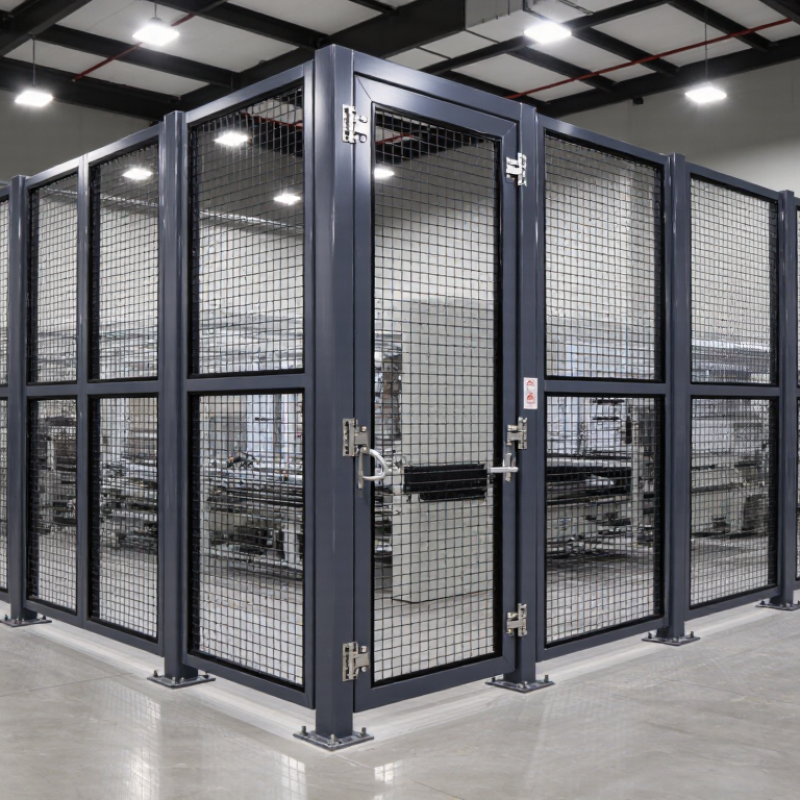
| 1 | Verify the required safety distance | Check the hazard zone, robot reach, moving parts, access points, and the stopping time of the machine. | The fence should prevent a person from reaching the hazard through or around the barrier. Calculate the distance using the machine risk assessment and applicable local safety requirements rather than selecting a standard height alone. | Can you provide the fence layout, mesh opening, panel height, and recommended safety distance for our machine? | Allow clearance for additional tooling, conveyors, cable routes, and planned robot motion without reducing the required separation. |
| 2 | Review installation conditions | Assess the floor type, unevenness, available working space, anchor points, overhead obstructions, and installation sequence. | Confirm the anchoring method, base-plate dimensions, required tools, tolerances, and whether the system can be assembled without dismantling nearby equipment. | Are assembly drawings, anchor specifications, torque values, and installation instructions included? | Use modular panels and adjustable posts where possible so sections can be relocated or added without replacing the complete fence. |
| 3 | Confirm machine and safety-device compatibility | Check door switches, guard-locking devices, emergency-stop controls, safety scanners, light curtains, conveyors, and control-system interfaces. | Every access door should be integrated with the machine safety circuit so that opening the door initiates the required safe state. The fence itself must not obstruct sensors or emergency access. | Which door, hinge, lock, switch, and cable-management options are compatible with our safety control architecture? | Reserve connection points and cable pathways for additional interlocked doors, sensors, or safety equipment. |
| 4 | Select suitable materials and surface protection | Consider impact exposure, corrosion, humidity, cleaning chemicals, temperature, welding sparks, and indoor or outdoor installation. | Choose a finish and material that match the environment. For corrosive or washdown areas, verify corrosion resistance and cleaning compatibility instead of relying on appearance alone. | What material grade, coating process, coating thickness, and corrosion-test information can you provide? | Use replaceable panels, posts, and fasteners so damaged or upgraded sections can be serviced independently. |
| 5 | Evaluate access, visibility, and maintenance ergonomics | Map operator entry, material loading, inspection, cleaning, tool changes, and maintenance routes. | Provide enough access doors and removable sections to avoid climbing over the fence or bypassing interlocks. Transparent mesh can improve visibility while maintaining separation. | What are the clear opening dimensions, door swing options, latch arrangements, and maintenance-access provisions? | Select reversible doors and standardized panel sizes so access points can be moved as production flow changes. |
| 6 | Check compliance documentation and validation support | Review risk-assessment inputs, technical drawings, material records, installation instructions, inspection procedures, and safety-device documentation. | The final guarding solution should be validated against the hazards of the complete machine cell. Documentation should identify dimensions, access points, interlocks, and inspection requirements. | Which standards and test methods were used, and can you provide a complete technical file for review by our safety team? | Request revision-controlled drawings and an equipment list that can be updated when the cell is expanded. |
| 7 | Compare total cost, delivery, and long-term support | Compare engineering, packaging, shipping, customs, installation, spare parts, training, and maintenance costs—not only the panel price. | Obtain a line-item quotation with dimensions, quantities, incoterms, lead time, warranty conditions, replacement-part pricing, and recommended spare quantities. | What is included in the price, how are replacement parts identified, and what support is available in our installation region? | Confirm that identical or interchangeable modules will remain available and that future orders can use the same connection dimensions and finish. |